Saturday, April 23, 2016

Last Post From Dakar

So, as has been mentioned, my stay here has really come to its end. My flight leaves tonight, and I should arrive back in the US on tomorrow evening (fingers crossed!).

The past few weeks have been a really nice send-off. I finished up my time at APECSY last week, and celebrated my birthday with friends with a picnic at Îles des Madeleines last weekend.

Left to right: Me, Claire, the ferryman, Jillian, and Bennett. Photo by Brenda.
This week I had my final classes and presentations for MSID. I've said so many goodbyes already, and it's terribly bittersweet. I prefer "ba beneen yoon" (until next time) and "au revoir" (goodbye, but more literally, to meet again) to anything more final, because I know I will be back.

I remember coming here and having trouble believing I could ever feel at home here. Yet today, I went to the market in HLM for souvenir shopping (a lot of cloth, candy, and tea), and began walking away in search of a set of tea glasses. I was walking in the direction of Mermoz, where I live, and decided I would take a taxi when I got tired or lost. As it was, I made it all the way back - this after I got lost in my own neighborhood the first week! It felt like a real accomplishment.

I shared my last plate of ceebu-jën with my host family this afternoon, though we still have dinner to look forward to tonight. I'll be doing a little more shopping and hanging around, and trying to let the knowledge that I'm leaving in under eight hours set in. It still hasn't.

Sunday, April 10, 2016

What I've Learned

Today is two weeks to the day until I leave. It's a little over a week until my 21st birthday, which I suppose is a day that might merit its own post. I thought I'd talk a little bit about what I've learned here.

Sit down - there's plenty of hammocks to go around!
I've been more or less composing this piece in my head for months now. A clever sort of summary of how I've spent my time here, of wisdom I might impart to myself a year ago or someone else considering studying abroad in Senegal who could use the advice - or even for those of you who will never see Senegal, whose most personal experience with the country has been reading my haphazard posts about it these last seven months. So here's another quick list of odds and ends I've picked up this year:
  • I've learned a new kind of table manners, which really aren't table manners at all but bowl manners. There's a clumsy way of eating rice with your hands and a polite way, and I think I've gotten a handle on the polite way. I say I think, because really I've also learned that sometimes you can spend a very long time being what Dave Barry calls an "American water-buffalo" without realizing it. At least I only slipped up and put my left hand in the communal bowl once.
  • I've learned how to interpret and navigate a lot of social customs and patterns that I was previously unfamiliar with. Greetings, for instance, are a lot slower here and more important. While I still smetimes get frustrated with how long they can drag on, I wonder if I'll feel at all cut off when I go home and experience the shorter American greetings again. As far as other languages differences go, some kinds of offers and requests are meant as jokes (like asking for my hand in marriage at first meeting) or a sign of unending hospitality (like encouraging me to eat until I thought I would explode). At first it was a little hard to tell which is which, but I think I've gotten the knack of it.
  • I've learned how many other, smaller things are local customs, rather than just universal behavior. For instance, during my summer working the register at Pekara, I was taught that it was my responsibility as the cashier to always have correct change on hand and in the register. I assumed that held true everywhere, but did not account for a place where much less money passes through most businesses each day. Here, exact change is the responsibility of the customer, not the seller, and some shopkeepers here can be downright rude if you try to pay in big bills (about the equivalent of $10 or $20 bills). In one case, I visited three different stores in an effort to break a 5000 CFA ($10) and ended up in a pharmacy buying a small box of painkillers I didn't really need just because I needed change for the bus. I can't imagine the look I would get if I ever just asked for change from the register without buying anything.
  • I've learned how to efficiently haggle for a taxi, and a lot more about navigating Dakar's public transportation network - so much so that I have a separate post about that that I'll post tomorrow or the day after. Haggling in general is an interesting approach to buying and selling that I'll miss in some ways - though in others I'll be glad to get back to just hearing a price and knowing it means something other than "I think this is the most I can get you to pay for this."
  • I've learned some more overarching lessons as well. I've gotten a little better about not panicking in strange and unfamiliar situations, and much better at saying "buzz off" to people who I get a bad feeling from. I've learned that even life in a big, exciting city is not enough to change my love of afternoons staying indoors with a good book. I've learned that I think I'd like to do something different with my life than what I thought when I first came here.


If I've learned so much from just the past short months in Senegal, I can't imagine what a lifetime of travel to other interesting places can do to a person. I certainly hope to find out!

Sunday, April 3, 2016

Personal Reflections


NOTE: I wrote the original version of this essay for a class assignment, but I thought I'd also post it here, as it discusses a few of the more difficult aspects of my stay that I haven't discussed on this blog. I always want to keep this space "pleasant" and not fall into the trap of ranting or oversharing. I felt this essay struck a difficult balance between that, and telling the truth.

I got a call last Monday from my friend Samba, the man whose job it had been to help me acclimate to life in Soussane. I had been expecting him to call sometime in the last few weeks, but I didn’t have the courage to call him myself. He started the call with the words I wanted to hear the least, but that I knew were true. “You’ve failed us, Lalla,” he said, addressing me by the Senegalese name I had gone by in Soussane. “You have not come back.” When I left Soussane, I had said I would return, though the truth was I didn’t want to, and because I don’t have a car I knew it wouldn’t be likely. I told him this, and he didn’t seem surprised. He had always seemed a little dismissive of my involvement with the village and Senegal. “I don’t think you will ever be a farmer, Lalla,” he had said one day as we were hoeing onions. “You’re a city person.” I proved him right within a week of this, deciding to leave when I realized how futile my time there was.

To start at the beginning, I was assigned to the village of Soussane for my internship this semester by Agrecol Afrique, whose offices I worked at last semester. In retrospect, it’s very clear that I was almost totally unprepared for a three-month stay in the village. . I hadn’t lived in a house without wifi in years, and no electricity was way more of a transition than I thought it would be. It was more than a little frustrating to have spent over a year learning Wolof and find it totally useless in the very situation I had planned to use it most. My research was not in place enough for me to start conducting interviews or doing any kind of fieldwork. I felt adrift, and what’s more useless. Any work I could do in the village felt like an indulgence, as though people were showing me how to clumsily do something for a few months that they themselves had been doing expertly for years, and would continue to do for years after I had left.

Despite all this, I still liked Soussane. My host family and the rest of the village were kind and welcoming to me. While some of the food was a very stark reminder of the kind of poverty most of the village lived in (I’d never eaten sandwiches with spaghetti before), I also found I really enjoy millet couscous with all the various sauces it was served with. It was quiet and peaceful – the entire pastoral ideal was always at the front of my mind there. I saw so many stars and the most beautiful sunsets, and the background noise of the cows and goats was much sweeter than the traffic of Dakar.

Still, I cried almost every day I was there. Most of it was over little things. I cried because I missed my home, because there was trash blowing around the village and rotting just outside its fences, because one of the family members had a chronic illness that didn’t appear to be getting better, because I wished I were a dentist because no one there had decent teeth. I cried because I thought of what they would do with a fraction of the wealth I’m used to seeing people blow away – that I’m used to blowing away. I cried because I hated that I felt sorry for them, when I had no right – when the little girls work harder than I ever have a day in my life, and will until they’re bent old grannies. They shouldn’t have to. They’re amazingly strong. I cried because I realized that I was not needed, and that I had been foolish to come here.

I have decided over the course of this semester that development work, at least in the vein I have been pursuing it, is not for me. Rather than serving a term in the Peace Corps after graduation, I think I am going to apply for a master's program in library science. I would like to specialize in knowledge management (something I learned about at Agrecol, and which I found very interesting), and I wouldn’t mind one day returning to NGO work as a knowledge specialist. But note that: specialist. I am not coming back to work in the developing world until I know I can bring a useful skill set to it. I have learned the hard way that that does not do much good for anyone.

I regret a lot of things about how I have spent my year here in Senegal. If I could do it all over again, I would have spent my first semester internship in the village, when I was less pressured to get work on my research project done, and my second semester in Dakar or Thiès. Perhaps I would have been happier that way, and maybe I would still be on the development path if that had come to be. But I like to think I have returned to a truer path here. I am grateful to the MSID program and to everyone else who has helped me along my way here. Samba and the Diones, my host family in Soussane, are among those who I am not sure if I will ever be able to repay. I did not want to come here and be a silly American, taking experiences as if they were photographs and discarding people I meet like business cards, but I have. Monetarily my debts are settled, of course. But it will be a long time before I will feel they are met morally.

Wednesday, March 23, 2016

One month left

Here's the March update, as once again it was a slow (read: no) posting month. There hasn't been much to report on besides business as usual - work, reading, knitting, friends. My life here has taken on a very routine and normal feeling - and yet I have very little time here left. A month from today I'll be getting on a plane back. It feels crazy.

I will be happy to go home. There's no doubting that. I miss my family, my friends, my pets. There are plenty of other little things I never considered, either - green parks (there is not an abundance of public parks here, and they are generally a little sandier than what I'm used to), peanut butter (I use a bit of the peanut paste my host mom keeps for cooking to put on my bread on occasion, but it's not the same), good coffee (Nescafe cannot compete with a good soy latte). There's so much I am looking forward to seeing and doing this summer.

I'm definitely also going to miss it here though. Dakar worked its way into my heart little by little, and suddenly I found I had a pleasant routine here. I can't possibly talk about all of it, but here's a short list of some of the things I know I'll miss most.


  • Lively Neighborhoods


I'll miss walking around Yoff and Mermoz a lot. Kids play unsupervised around the neighborhoods here, something I've never seen much of in the US. I frequently have to step around or through games of marbles, soccer, and tag. In Yoff especially I can still rely on shouts of "Bonjour toubab!" which I have more or less gotten accustomed to.

Animals also make the city a little livelier. It seems as though I can hear sheep bleating everywhere I go in Dakar, as well as the clip-clop of horses' hooves. There was a rooster crowing on my street for a while, but I believe he's met his fate. The kitten at WARC is thriving (as any cat fed a good amount of chicken scraps would be).

  • Good eats

I'll miss the lunches and dinners around communal bowls, though I don't think the transition back to western-style serving will be too difficult.  I will miss the wonderful plates served, however, and I'm going to have to work on learning a few recipes before I get back. I've got plans to try serving trout yassa-style (grilled with onion sauce and white rice). I also need to get much better at my tea-pouring skills.
    And that's not to mention the street food - something I didn't explore for a while, but have had a very good experience with. My favorites are the grilled sticks of liver and onions, fried egg sandwiches piled with french fries, and even the overpoweringly bittersweet Cafe Touba. I have to say, I'll also miss being able to buy all of these for less than $3! 

    Sharing a sandwich with Claire at our favorite lunch stand near WARC
    • Teranga (hospitality)

    I'll miss the pleasant little interactions that follow day-to-day life here. Today, for instance, I went to the tailor to pick up some things, but ended up waiting a bit while they were adjusted. While waiting, I had a series of conversations with the employees and customers of the shop and the beauty parlor next door (I was knitting, and it seems everyone the world over loves to talk about my knitting). We shared bissap juice, millet flour beignets, and ataaya. That's the real Senegalese teranga, that kindness that I'm still so enchanted by.


    I know already that I'll be back here someday. Not to live again, but I will be back. I want to see Dakar grow, and Senegal with it.

    I've got a couple other posts I want to get up in the next few weeks. Thank you for your readership and patience!


    Saturday, February 27, 2016

    February, in brief

    I've never been as good about keeping diaries, blogs, or journals as I would like to be, and so the month of February has almost passed me by without a single post. Rest assured, I'm doing very well.

    I'm back staying with the Kobars, and the house has been rather lively of late - some family friends are staying at the house right now, and two former MSID students stopped by this week as well. One works at an organization that does work here in Dakar, so comes through infrequently, and the other is on vacation from her job in France and chose to come back for a bit of sight-seeing. The spring MSID students are on their Toubacouta trip right now - I can't wait to hear about how it went.

    I've started up a new internship with a group called APECSY(L'Association pour la Promotion Economique, Culturelle, et Sociale de Yoff), a community development organization in Yoff. Yoff is a neighborhood in the northern part of Dakar. It's about a twenty-minute bus ride from my host family's house, and I have to say I've come to enjoy the commute. Usually, I snag a seat and pull out my knitting - I've finished a kerchief and I just started a new knitting project which I'd like to keep a secret for the time being.

    Yoff and Mermoz are both circled in blue. I take the yellow-green route between them.

    I'm mostly observing at the organization right now, though I also did a bit of translating for an informational brochure and went around with my supervisor, Oumar Diene, for a look at some of the problems and successes of the neighborhood. I like Yoff a lot - like any city, all the neighborhoods of Dakar have their own character, and Yoff is a bit slower than downtown or Fann. In some ways, it's a bit more like Thiès - more horsecarts and a thriving street market, though it also sits directly on the beach, and still derives a lot of its industry from fishing.  It also boasts a high concentration of Lébou people, the original inhabitants of the peninsula on which Dakar sits.

    Me (center) with the members of the women's group AFADY and fellow APECSY employee Mame Diene (holding baby).

    Outside work, I've been doing a bit of sightseeing and generally enjoying Dakar life. I've got a good group of friends here and we've been exploring some of the cuisine and nightlife Dakar has to offer - most notably, a Nigerian restaurant (which I wasn't terribly fond of), and an Ivorian restaurant (which I was), as well as frequenting Lalibela, a wonderful Ethiopian restaurant. I've had a few market & sightseeing expeditions with the new MSID students, including a wonderful cookout on the Mamelles beach with some CIEE students (another undergraduate study abroad program). I'm still not much of a dancer or a partier - even living in a city halfway around the world can't change this couch potato that much - but I have fun.

    I went to a wedding with the Kobars this week - I'd not gotten the chance before, but Senegalese weddings can be legendary events. This one was pretty chill by comparison to some, but it still lasted the whole day and long into the night, and the house was absolutely packed. Like in any social situation here, I felt severely underdressed - the Senegalese women are very glamorous dressers, and even the little girls were much more put-together than me. I'm having some new clothes made soon, though, including a dress in a rich purple bazin, the shiny, embroidered fabric favored for fancy clothes here.

    I've been reading a lot (as always), but I'd like to promote one of the books I read lately - Tom Burgis's The Looting Machine, a look at some of the worst of the corruption and resource theft which continues to keep many African economies in the red. If you have an interest in international economics and/or politics, I highly recommend it.

    I'm hoping I've broken my lazy writing streak with this post, and I'll try to get something else posted later this week. Thank you all for being so patient with my sporadic correspondence!

    Wednesday, January 27, 2016

    Quick Update: I'm back in Dakar

    Scarcely a few hours after I published my last post, which I'd drafted over the weekend, I thought over some things that I'd been dealing with since my arrival last Tuesday, and decided that my time in Soussane wasn't going to be worth it. Honestly, reading through that post with the knowledge that I get aggressively upbeat when I'm close to breaking makes it seem like a bit of a cry for help.

    A big part of me also wanted to stay, but I also knew I was not doing anyone any favors by staying there. Soussane needs a lot of things, but an unskilled young intern who is treated like a china doll is not one of them, and I was not thriving there. The people in Soussane were wonderful, but a stomach bug, a general sense of frustration at the resources available to me there, and the fact that I'd had no warning or information about the site beforehand made me feel very frustrated at being sent there, and I was so upset Monday I was seriously considering going home. I was having some trouble adjusting to not having sufficient internet connection and electricity, which I'm pretty dependent on because I've built a lot of my research and writing habits around using my laptop.

    So I'm back in Dakar this week, figuring things out with MSID and finding another place to work this semester. Rest assured, I'm still staying in Senegal until April, but I'll be doing something different. Thank you all for your continued support and readership.

    Monday, January 25, 2016

    Mbaldoo!

    (m-bahl-doh)

    That’s how you say “good morning” in Sereer. If someone says that to you, you respond with “fedee jam” (fay-day jahm). Then there are several greetings asking about the family and your health that follow, and other ways of greeting each other during the afternoon or evening. Salutations are serious business in the village of Soussane.

    Soussane, not to be confused with Sessene (a small town along a main road where Agrecol has an office), is a hamlet of a few dozen families, five kilometers of dirt road away from the main route. Agrecol though it would be best to send me to one of their newest sites for my internship, and they just got their organic gardens at Soussane off the ground in the past year.

    In some ways, it’s rather like my fantasies of the Little House books as a girl – the town still gets all its water from a well (though I buy bottled drinking water because of my weak American stomach). My host father is the head of the village, and so we were among the first to get electricity, which is still being installed in other homes – until those arrived, only the school had electricity. It is enough to power lamps in the evenings and to charge cellphones, but to charge my computer I have to go a little further afield.

    I can either ask a neighbor on the other side of town who has a more powerful electrical system, or go to the Agrecol offices (a journey which can range between fifteen minutes and an hour, depending upon whether I go by horse cart or car), or to Beersheba, a little under a mile away. Beersheba is a faith-based center which offers training in organic farming. The latter two have wifi as well, though I also have a 3G internet connection if I want to work at home. It’s a bit slow out here though, so I can’t post any pictures as yet.

    So far, my schedule is split between helping at the village preschool a few mornings a week, helping with the organic farming, and doing things with the Agrecol offices. I can’t start conducting interviews until I get IRB approval, which I’m in the process of applying for, but until then I can do a lot of reading – as usual, I practically brought a mobile library with me.

    The food is a lot more carbohydrates and a lot less meat and vegetables than I’m used to – at this rate, I think most of my body mass will be millet by the time I go home. Fortunately, I’m rather fond of it, and I really love the feel of meals eaten around the communal bowl.

    Soussane is not the kind of place that gets all that many newcomers, and certainly not white girls like me, so all the kids here find watching me to be endlessly interesting. If I just sit down outside with my journal or my knitting, a crowd of them will gather. All except for the littlest ones – I still frighten some of the babies.

    As per the usual, everyone, adults and children alike seems to like to watch me knit – I really wish I had brought teaching supplies with me, but I shall have to figure something out.


    There is so much to say about life here that I have to cut myself short for this post – I’ve got a couple themed pieces in mind for later. Will post a lot more in the weeks to come!

    Friday, January 15, 2016

    First post of 2016!


    And what a year it's already shaping up to be! I dropped off the radar for the last month while my family was here, and then I spent the past two weeks getting my research project ready. After we help with the orientation for the spring MSID students next week, I head off to Sessène on Tuesday! Crazy, right?


    A lot of the highlights of our trip have been available on facebook, but to recap (photo credits to Karen Carney):

    We spent the first few days in Dakar:

    In front of the Marche Kermel

    Mom and I in front of the Theodore Monod Art Museum
    Will, me and Dad in front of the UCAD library
    Île de Gorée
    Then on to Saint-Louis:

    Will and I at the Hotel Cap Saint-Louis

    The pelican nesting grounds in Djoudj National Reserve
    And then on to Toubacouta:

    Dad in a baobab
    The Hotel Keur Saloum
    Green Monkeys hung around the hotel begging for (and stealing) food
    And back to Dakar. 

    Downtown Dakar
    The Monument of the African Renaissance

    It was a really great trip, and I miss those folks already! Still, I feel pretty good about the next few months. Next post should be from Sessène!

    Sunday, December 13, 2015

    Endings, Beginnings, and Milestones

    It's December 13, which means I've been in Senegal for over a hundred days. Wow. I'm back in Dakar right now, after a wrap-up week of fall semester classes. Most of the other MSID students were only staying the semester, and left or are leaving this weekend. I know the pictures are a big part of this blog, but sadly there are none this week, as (and I know it sounds like a ridiculous excuse) I in fact accidentally deleted the pictures that I had taken these past few weeks from my computer after having already taken them off my phone. Technology 1, Jane 0. >_<

    I had a nice week of activities - classes Monday, Wednesday, and Friday, with Tuesday and Thursday completely free. Tuesday Casi, Delaney, and I went to the world's smallest national park - the
    Parc national des îles de la Madeleine, or Madeleine Islands. There's one big island, the Island of Sarpan (pronounced like serpent, the French word for snake, which is a bit confusing as it is snake-free), as well as a few smaller volcanic islands. The geology of the island is amazing to look at, and it's also home to some tortoises, nesting cormorants, and, according to our guide, a patron spirit who looks after it. There's some ruins from a few European attempts to farm or settle the island, but it's a rather exposed rock, and gets too much wind to grow anything beyond grass and a few hardy baobabs. It made for a gorgeous day trip!

    Wednesday I had class in the morning and afternoon, but took a trip to the Artisanal Market between class and lunch with my classmates - I didn't have any money with me, so didn't buy anything, but other people stocked up on souvenirs, and I'll definitely be back. Thursday, Friday, and Saturday were split between a lot of writing and saying goodbyes. We had a wonderful farewell banquet Friday night.

    My parents and Will get here on Saturday, and I'm very excited! In the meantime, I'll be heading back down to Joal for a few days, working on some scholarship applications, and just kind of taking things slow. I've got a post on public transport that just needs some photos as well, so that should be up this week.

    Friday, December 4, 2015

    Slice of Life post: City Creatures

    My time in Thies is drawing to a close, and while I'll be very glad to get back to Dakar this weekend (I can't wait to catch up with my MSID friends, see my host family in Dakar, and get the end of the semester squared away), there are definitely some things I'll miss about living in Thies - among them, the sheer number of animals I see walking around the city.

    In Dakar, there are a few horse-drawn carts to be seen here and there, though they're much more common in the outlying suburbs than the downtown area. There are also a fair amount of other animals people keep, like the sheep my host family keeps on the roof. But Thies is a whole other story...

    First off, you have the donkeys and horses, which are used as pack animals - cars and trucks are much more common, but the cart hasn't bought the farm by a long shot. You can catch a ride to the market on one of the carriages as well - some of them like, the one in the background below, are outfitted with benches for passengers.

    City traffic moves a bit fast for my camera - even the non-motorized kind!

    A donkey on his lunch break

    The house I live in here is in a relatively new neighborhood on the outskirts of town, right next to the village of Thionah. It's a common sight to see goats wandering at all hours, and I can hear them along with donkeys and roosters throughout the day.

    There's something a little threatening about the way goats look at you

    Goats and a stray calf outside of a neighboring house
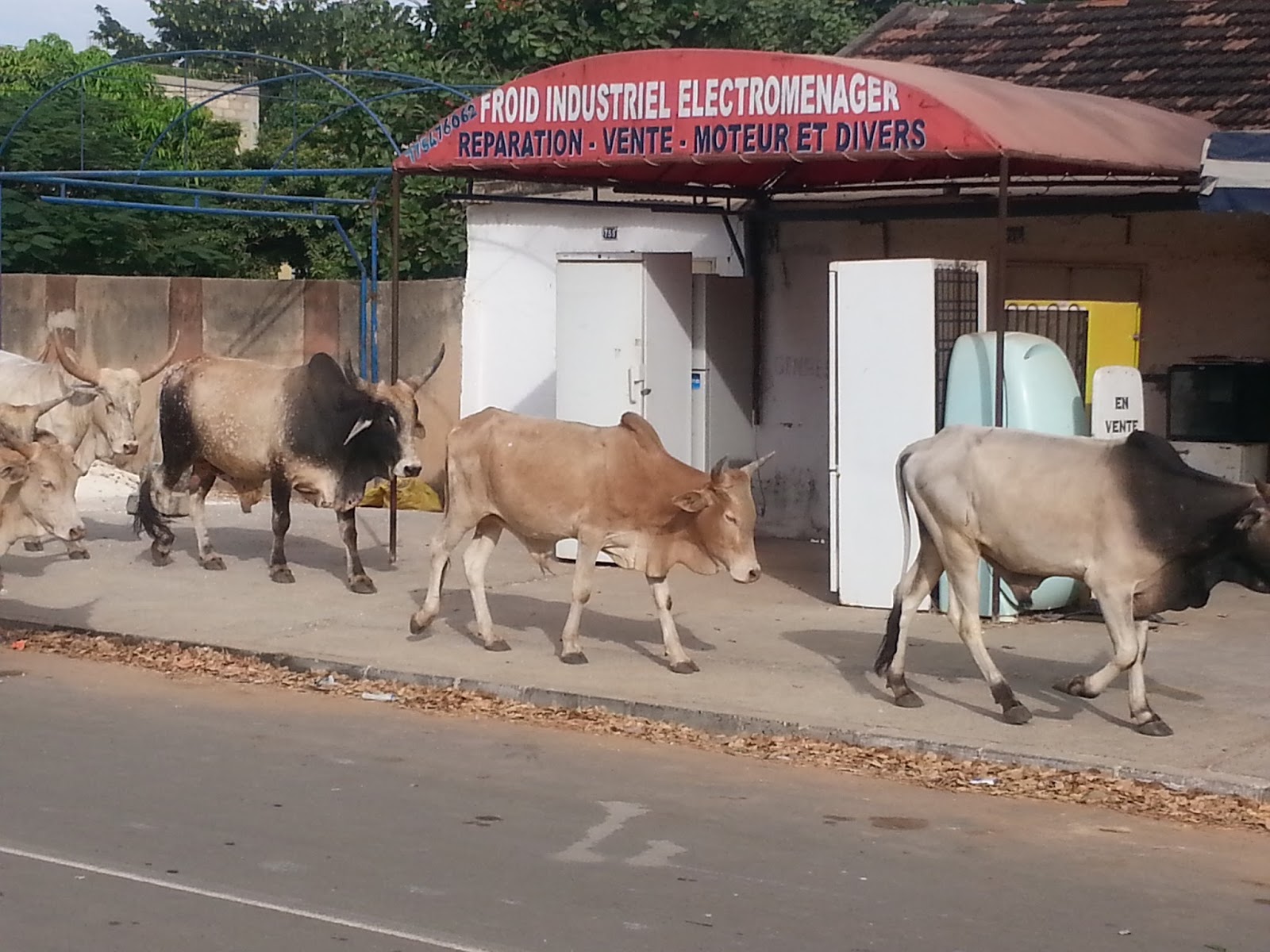
    "Well," you might say, "that's all very well and good, but that's just in the outskirts of town, right?" These, however, are from a herd of cattle that passed through town not too far from the offices of Agrecol earlier this week. I  complimented the cowherd in Wolof for having pretty cows (or at least I'm pretty sure that's what I said).

    Yes, that is a refrigerator store behind them.
    Some of you are probably familiar with my mom's adventures in urban chicken-keeping, which was the great family story of 2013-2014. Thies wouldn't dream of any such ordinance against livestock as is common in the States. The chickens here (roosters and hens alike, and I can usually hear a rooster or two in the mornings) roam a bit freer that our girls at home do.

    He didn't like me much

    "I said, 'cluck cluck'" said the hen

    Mammals generally aren't allowed to walk around the markets except on a leash, but chickens can't do as much damage to a market stall as a goat might. I found these guys scratching in between a general store and a hardware store.

    Granted, there are some downsides to this as well, chief among which is that the streets smell like a barnyard in places. But for all of the talk I hear (and contribute to) about ending factory farms and instituting better livestock-raising programs - maybe part of our problem has been isolating ourselves too much from the animals that we eat. I'm not giving my full endorsement to re-instituting such laissez-faire attitudes towards free-range livestock in the US, but I can say for sure that they certainly add a bit of excitement to the streets here!

    Monday, November 30, 2015

    Weekend Getaway

    My last few weeks in Thiès have been fantastic. I've gotten started on research for my senior capstone project, and I'm devoting this week to finishing up my end-of-semester projects, which are due next week - time's really flown by. I had a couple outfits made, which look fantastic, if I do say so myself.

    Here's one new outfit - and some cows! Claire and I saw these in the street, and wanted a picture. PC: Claire Dineen

    This weekend I left the city for a bit to go to Joal-Fadiouth with Casi and Delaney, some of my MSID friends. We caught sept-places (pronounced "set-palaass;" run-down stations wagons which you can take between cities for about $2-$4, depending on how far you're traveling. The price you pay for it being so cheap is being crowded in with at least six other passengers) to M'bour, which was pretty central for all of us, then got a taxi to Joal. We arrived very late Friday night at the Hotel Finio, a charming little inn right on the bay.

    Joal sits on the Atlantic coast, joined to the village-island of Fadiouth by a pedestrian bridge. No motor vehicles are allowed on Fadiouth, due to the island's unusual covering of shells. "Guards" try to get tourists to pay a fee of about $10 USD to cross the bridge, but in reality there is no fee. Mason, another American student who lives in Joal, showed us around and helped us negotiate fees and taxis like that. Noah, another MSID student, was visiting a relative of his host family in Joal and joined us on Saturday as well.


    There were many pigs around, a rare sight here despite the other animals commonly wandering the streets - most Senegalese are Muslim, and thus do not eat pork. Fadiouth, however, is mostly Christian, due to an old Catholic mission which still has a thriving cathedral on the island. I took a lot of pig pictures.


    We had a nice lunch out and met Mason's host family, before walking around Joal a bit. We saw the outside of the house of Léopold Sédar Senghor (the first president of Senegal), which is now a museum, but decided to go to the beach instead.

    There were lots of crabs around, and some little boys were all too happy to help us catch a few. 

    In the evening, we went to Mason's house for dinner, and hung around playing Uno with his host brother (aged six) while waiting for the food to be ready. We didn't let him win, but we did let him say that he won.

    The next day we had breakfast at the hotel, where this pelican hangs out - we saw him getting his breakfast as well, a bucket of fish. We think the hotel must feed him so he stays around, and I can't blame them, he does add a good ambiance to the place.


    We took a walk around the beach, then went out for lunch at the Taverne des Pecheurs (Fishermen's Tavern). The food was fantastic, though a Senegalese quartet came and played music right next to our table. Their style seemed to be "annoying enough that tourists will pay us to go away." We didn't give them anything, being rather sick of playing these kinds of games. I was reminded of Sir Robin's minstrels from Monty Python and the Holy Grail - luckily, we did not have to eat them to get them to stop.


    We took the same chain of taxis and sept-places back to our respective cities, for one last week of work and wrapping up. Should have at least one other post up this week, and plenty more photographs on the facebook!

    Monday, November 16, 2015

    Thoughts in the wake of this weekend

    This post also represents a departure from my usual style of posting, but as a student of global studies, I wanted to weigh in on the events of this weekend and the fallout. It’s no more than my two cents on the matter.

    I was very shocked and horrified when I saw the news of what happened in Paris on Friday night. In my way of thinking over the past few years, France was very “safe.” I struggled a lot my freshman year with the choice of where I wanted to focus my area studies and spend my year abroad. I really wanted to apply to study at the Political Science Academy in Paris, and experience the movable feast. But I also wanted (and felt I needed) to spend this year growing in a way I knew would be difficult in Paris. I chose Senegal to get a better sense of the larger world, because I want to work in development, and to experience a rather different way of life.

    Though Senegal is a stable, relatively healthy republic, West Africa is more or less synonymous in the news for Ebola outbreaks and armed conflict. Even though I felt comfortable in my decision, I know a lot of people felt I had chosen the less “safe” option for my year abroad, and at times before coming here I struggled with that myself.

    Do I feel less safe here after what happened in Paris? No less than I did before, which is no less than I feel at home in the US. It would be very, very wrong to lump the actions of the Islamic State with the piety and peace practiced by the other Muslims around the world, which include 12.5 million Senegalese, who look down on militant Islam the same way any sane person would. I have nothing but utmost respect for Muslims and Christians alike who continue to find a path to a better world using some of the same holy texts that others have used to declare justification for atrocities.

    But really, I’m not safe. None of us are. The reason all of the US and Europe is in an uproar over Paris is because it was, like 9/11, another glaring reminder that it can happen here, in “civilized places.” It doesn’t just happen in countries that still haven’t recovered from years of colonial rule, in places we have already written off as zones of violence and irresolvable conflict. Terrorism is not just their problem, and we are foolish to assume violence is ever so far from our door as to not merit our attention.


    I do not wish to offend anyone with my stumbling around these matters. Death and human suffering in any respect are not to be taken lightly or compared against each other. What happened in Paris was an atrocity, and my heart goes out in mourning to the victims and their families. But I must also mourn for Beirut, Syria, Iraq, Palestine, Mexico, and so many other places. I mourn for the hundreds of Americans killed by police violence every year. I mourn for all the unnecessary deaths due to violence and all other preventable causes. I take a moment to remember all the suffering that happens every day, and then I move on and live the rest of it to the best of my ability. We must mourn, but we must also go on living with peace and without fear. Wherever we are.

    Friday, November 13, 2015

    Slice of life post: Fun with Currency!

    So, up until now most of my posts have just been news about what I'm doing. I'm going to try starting something new, however, and making occasional posts that are just my experiences with day-to-day life in Senegal - things like public transportation, food, and culture shocks. Some of this is for my parents and brother, who will be joining me here for a few weeks' vacation during Will's winter break in December, and some of this is just to share all the little curiosities I come across here. 

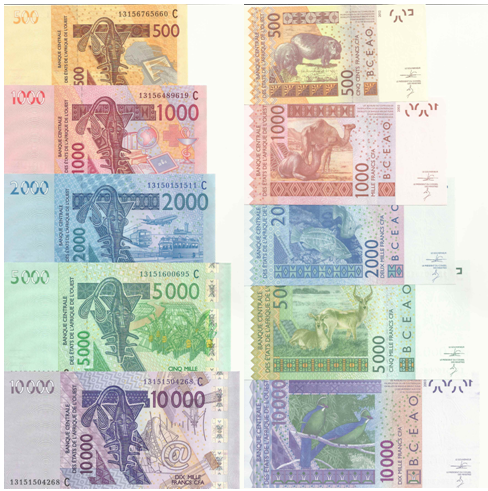
    One of the things that has been very interesting for me to figure out during these last few months in Senegal has been the different currency. Along with several other former French colonies, Senegal uses the West African CFA (CFA stands for "Communauté Financière d'Afrique" or Financial Community of Africa). The exchange rate is about 500 CFA (more commonly known as "francs") to the dollar, though it fluctuates regularly to be about 50 CFA above or below that. 
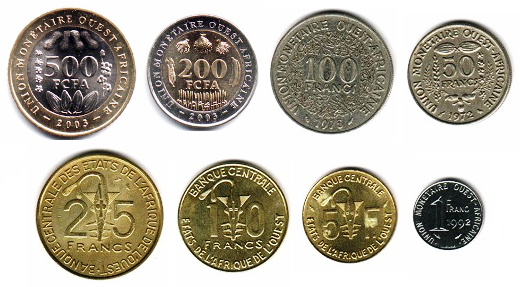
    Image from https://en.wikipedia.org/wiki/West_African_CFA_franc#/media/File:BCEAOFranc.png
    Image from: http://africanbanknotes.blogspot.sn/2013/12/west-african-cfa-francs-banknotes-set.html
    Technically, there are eight coins and five bills, though only the five largest coins are in wide use - I've only run across a few 5 and 10 CFA coins, and never seen a 1 CFA. There is no sales tax, so prices are always exact, usually in increments of 50 CFA.

    Prices are seldom marked on items here, and this combined with the ingrained culture of haggling means that the Senegalese are very good at remembering what they pay for things. I still get some funny looks for asking what things cost in stores, because they're used to people my age just knowing how much things are. I've started to memorize a fair amount of prices myself - 1.5L water bottles, for instance, are 400 CFA, whereas the same sized bottle of soda is 700 CFA. Here is a sample of what you can buy with each amount of money in Senegal:

    1 CFA - Like I said, I am still not sure if these coins are worth the metal they're made of. I haven't run across anything so far that only costs so little. 

    5 CFA - one of the sticks people use to clean their teeth. Yes, you read that right, you can buy whittled, cleaned sticks from food stands and shops to keep in your pocket or the side of your mouth and scrub your teeth with throughout the day. Toothpicks and toothbrushes are also used, of course, but the traditional method of chewing and scraping with sticks after meals persists, even in the cities. I haven't tried it yet, but apparently it's a rather effective supplement to regular brushing. 

    10 CFA - a piece of hard candy from a corner shop. The corner shops themselves are a whole other fascinating post, but no matter how small the shop they always keep a few jars of different candies on the counter for children (and exchange students with a sweet tooth) to buy with their allowance. I'm rather fond of gingembre, a very strong hard ginger candy. 

    25 CFA - still haven't found anything that costs exactly 25 CFA, but useful as halves of a fifty.

    50 CFA -  A little bag of beignets (a kind of doughnut hole) or a small cup of Cafe Touba from one of the street snack carts, a short ride on a car rapide (price varies by distance traveled, but 50 is the base price), or a sandwich-sized, vacuum-sealed plastic bag of purified water (an alternative to water bottles; you bite a hole in a corner and drink from that). 

    100 CFA - A small orange, a small baguette, a regular cup of instant coffee, a single-serving packet of cookies, about a cup of freshly-cooked peanuts, a short ride on one of the nicer city buses, a banana, or a 10-pack of tissues. 

    200 CFA - a ride on a "moto," the taxi's two-wheeled cousin in Thiès. Young men drive them around the city and shout "moto" at pedestrians who look in need of transportation. Motos are two-seater mopeds or motorcycles (though I've seen ones with three or four children on the backseat instead), which provide a cheaper alternative to taxis, for the single passenger without a lot of baggage. 

    500 CFA - a taxi ride in Thiès, a very basic lunch of ceebu-jën from a food stand, a family-sized package of cooked peanuts, or a breakfast sandwich with meat, potatoes, and vegetables. 

    1000 CFA - lunch from a slightly more upscale food stand (that serves sandwiches or Senegalese food that is not ceebu-jën), a cross-city taxi ride in Dakar, a toothbrush, or a 10L bottle of purified water.

    2000 CFA - a taxi ride if you're really bad at haggling or it's raining (price goes up because demand goes up), or a SIM card for a cellphone. 

    5000 CFA - a portable 3G internet connection, 2GB worth of data for your phone or 3G internet, or two meters of good cloth, which is about enough for making a dress. 

    10000 CFA - usual cost for having an outfit made by a tailor, though often negotiable if you are able to buy the cloth from the same shop. 

    As you can see, a few dollars can go a very long way here. The more upscale or western-style restaurants that I've been to in Dakar are only expensive in that they charge more what I'm used to paying for a lunch in the US. I haven't done any independent travel yet, but apparently the same is true for hotels as well - even the fanciest hotels listed in the guide don't generally go above 60000 CFA a night. Cost of living is balanced out by the high-cost of utilities, which are all privatized, but for travel it's very easy to do on a student's budget. 

    Tuesday, November 10, 2015

    Toubab Dialao and a village visit

    My first few weeks with Agrecol Afrique have been a lot of fun so far, and I'm learning so much here. Agrecol is a non-profit NGO, and so while there are mostly regular paid employees, there are also a few interns from Senegalese universities, as well three volunteers/interns from SUCO, a Canadian volunteer organization that is a little similar to the Peace Corps. They're Quebecois and speak mostly French, but enough English that our conversations frequently slip into a mix of the two. It's still difficult for me to properly express myself in French when I get excited or angry about a topic, and agriculture has its own vocabulary which I am doing my best to learn.


    Monday and Tuesday the whole organization, about thirty people total, had a conference and retreat at Toubab Dialao, a tourist town on the Petit Cote which is about an hour and a half's drive from Thiès. We stayed at the Sobo Badé, a lovely sprawling collection of bungalows built out of stone and decorated with seashells. It sits right on the edge of the sea-cliffs, and there was a lovely breeze around. We went swimming in the ocean - the first time I've been swimming in the ocean here, as I never found the time to go in Dakar. It was a lot of fun, though the waves were much stronger than I'm used to, my other major experiences with the ocean being on the Florida side of the Gulf of Mexico and in South Carolina. At night, me and a few of the Canadian volunteers went out in search of a drink (the hotel bar was ruinously expensive) and when we were walking along the beach, we saw hordes of little crabs scuttling about, which made me rather nostalgic for family ghost-crabbing adventures. I didn't get any photos, as I forgot my smartphone and my camera is being a little difficult right now, but there are some of the hotel on that link, and here's a few my coworker Abdoulaye took:

    Crocheting by the seaside
    The view from the cliffside - those are fishermen on the left
    We also got some real work and conversation done - I got to see presentations on all the major projects of Agrecol Afrique, including a food security program in the Casamance (I wish I were able to do work there, but security concerns mean that MSID does not usually allow students to work there), a shiny new version of the website to be revealed soon, and a presentation on the Naturel-Biologique labeling program, or Nat-Bi (biologique means organic in French). I may be able to do some work with the Nat-Bi program in the next few weeks, if my schedule permits.

    Wednesday I got back to find that my library project has been a little derailed - what little progress I had made had been undone by a well-meaning janitor stacking the books back in the closet, rather than leaving them in the organized piles I'd had them in on the floor. To them, I'm sure it looked like I had just thrown them willy-nilly around on the floor, but there was the beginning of a system there! I never thought I'd daydream about steel bookcases with movable shelving, but when all you have to organize with is a dirty closet,with three tall, deep shelves, what were once the most mundane solutions seem very appealing. I think I'm going to put the project on hold until (unless) we can get a hold of some milk crates or other boxes for organizing the books - otherwise I'll just be putting them in slightly more organized stacks, which, much as I hate to say it, is not a very good use of my time.


    Thursday I went with the technicians to see some of the field sites where Agrecol does work - three villages, two with women's collectives and one with a general farming collective. At the first village, Koulouck, we brought seeds and helped plant a few beds of onions. In the second, Mboulouckhtène, the program focuses on okra production and chickens - meat, not eggs. Ngemme, the third village, hosts the largest collective - 17 men and 10 women each work large plots of organic tomatoes, peppers, hibiscus, and other vegetables which they then sell to Agrecol. We had ataaya, freshly roasted peanuts, and vegetable stew with rice with the farmers in the shade of a baobab and weighed and recorded the harvests of the week. It's very odd for me to see a land in full bloom in November, after growing up in a place where there's only one growing season, which has already passed by this time of year. 


    My second week in Thiès was very well-spent, and I look forward to the adventures that this week will bring! 


    Thursday, October 29, 2015

    New town, new job!

    So classes wrapped up without incident last week, and this week we MSID students start our internships. Two students stayed behind in Dakar for internships there, but the rest of us boarded the bus (the same one we took to Toubacouta) Monday morning to travel to our new towns, scattered over the southwestern region of Senegal.

    Thiès is on the left, close to the ocean
    I was the second one we dropped off, as I'm only an hour outside of Dakar. I'm in Thiès, the second largest city in Senegal and the capital of the region of the same name. With about 274,000 residents, it's still a bustling metropolis compared to a lot of the country, but after Dakar it's like a slow, small town - definitely more my speed.

    A view of the main road I take to work every day

    Its market, open every day of the week, is a wonderful place which one could almost get lost in. I pass through it every day on my way from my house on the edge of the city, where I live with the Seke family, to my internship, which is closer to the town center. I plan to explore it a little more fully this weekend, and write a bit here about it.

    I'm working with Agrecol Afrique (their website is unfortunately only in French right now), an organization which promotes sustainable and organic agriculture in the Thiès region. I'm spending this week learning about all of their projects, and choosing which I will work with for the next few weeks. I'm here for six weeks total, and then after my winter break I'll be in Séssène, doing more direct work and research with the farmers who partner with Agrecol. 

    Madame Sira manages the store for organic products from growers partnered with Agrecol
    It's all rather new and exciting, and I feel as though I really have the chance to accomplish something here. At the very least, I'm planning to organize Agrecol's library a bit - it has serious need of some alphabetization, and luckily organizing books is one of my favorite hobbies. 

    Ba beneen yoon! I'm glad so many of you seem to enjoy my haphazard notes about my journey, and promise to try being a little more regular with my posting!

    Wednesday, October 28, 2015

    Toubacouta!

    Note: I planned to get this post up as soon as we got back (3 weeks ago, darnit), but once again, things happened. I'll post this today, then a little more about the events of the last few weeks tonight or tomorrow.

    Wow! Toubacouta sure was something!
    We left Dakar bright and early Thursday morning via tour bus,


    The total drive took a little over five hours, with some stops in between to take the ferry to the other side of the Saloum (we got there just as it was leaving, so had to wait about a half hour for it to come back), and to have a delicious lunch of ceebu-jen and ataaya in Sokone with the family of the WARC director.
    Ceebu-jen - the national dish of fish, rice, and vegetables!

    It's not even lunch here if you don't have ataaya after!
    We arrived at our hotel around mid-afternoon. We stayed at the lovely Club de Vacances Kairaba, a very cute hotel just outside of Soucouta, the twin town of Toubacouta. It had a pool, great food, and these terribly cute little cabins which we stayed in:

    Our activities over the course of our four-day stay included:

    • A visit to a local health center
    • A boat tour of the mangroves
    • Class in the forest on the agricultural economy of Senegal, followed by a visit to the village of Keur Aliou Gueye to talk to the villagers about farming
    • A lively evening performance by a local dance troupe
    • A visit to the community radio station

    • A visit to a women's microfinance and farming collective

    A plant from their peanut fields

    • A visit to a daara, a traditional Qu'ranic school

    • A lutte match, the traditional wrestling of Senegal. Lutte competitors are sports heroes here.
    We also walked around Toubacouta a fair amount, and saw some beautiful sunsets.


    I plan to go back during my break this December, when my parents and brother come to visit me. It'll probably be more crowded then, as December and January are the peak of tourist season here.

    You can see the full photo album of my pictures from our trip here.